
Key Takeaways
- When doing stop shot pool, to make the cue ball stop dead after contact, it must be sliding, not rolling or spinning, right at the moment it hits the object ball.
- Short shots need only a slight below-center hit. Longer shots require a lower tip position and firmer stroke to overcome friction and stay in the slide zone.
- Mastering the stop shot pool means knowing how the cue ball transitions, from backspin to slide, to forward roll, and striking during the slide phase for maximum control.

Stop Shot Pool. Source: Pool Dawg
Upgrade your cue and take control of every shot with Pearson® Cues. Whether you’re refining your technique or just getting started, Pearson® shafts will give you the precision you need.
Visit Pearson® Cues today and find your perfect fit.
What Is Stop Shot Pool?
A stop shot pool is when the cue ball is sliding (not rolling or spinning backward) at the exact moment it contacts the object ball. When this happens on a straight-in shot, 100% of the energy transfers from the cue ball to the object ball, causing the cue ball to stop immediately at the point of contact.
This might sound simple, but there’s actually fascinating physics behind it. As Dr. Dave, a well-known pool physics expert, explains, the stop shot pool is the perfect demonstration of the conservation of energy and momentum. In a properly executed stop shot pool on a straight-in shot:
- All of the cue ball’s momentum transfers to the object ball
- The object ball takes off with the same speed the cue ball had at impact
- The cue ball stops dead because it has transferred all its energy
This perfect energy transfer is what makes the stop shot so predictable and reliable once you’ve mastered it. It’s like a reset button for the cue ball – giving you a known position for your next shot.
Pool Stop Shot vs Stun Shot
A stunning shot is when the cue ball hits the object ball while sliding (no spin) on an angled shot, causing it to bounce off at about a 90-degree angle. It’s a go-to shot for players who want to control cue ball direction without relying on spin or follow-through.
Yet, many players can easily get confused between the pool stop shot and the stun shot. Here is a detailed comparison table:
| Feature | Stop Shot | Stun Shot |
| Cue Ball Contact | Sliding at the moment of contact | Sliding at the moment of contact |
| Shot Angle | Straight-in shot only | Angled or cut shots |
| Cue Ball Reaction | The cue ball stops dead in place | The cue ball glides off at roughly 90° to the object ball’s path |
| Purpose | Freeze the cue ball for the next shot | Control the cue ball’s side path for positioning |
| Execution Tip | Hit below the center with a level stroke | Hit below the center with a level stroke |
| Difficulty Level | Easier to control with a wider margin of error | Requires more precision with angle and stroke speed |
Understanding The Cue Ball Motion of Stop Shot Pool
To truly master the stop shot pool, you need to understand what happens to the cue ball after you strike it.
When you hit the cue ball below center, you impart backspin (also called draw or bottom spin). However, due to friction with the cloth, this backspin doesn’t last forever. As the cue ball travels:
- First phase: The cue ball slides across the fabric with backspin
- Transition phase: The backspin gradually diminishes until the cue ball enters what we call the “slide zone,” where it’s simply sliding forward with no rotation
- Final phase: If it travels far enough, the cue ball eventually starts rolling naturally with forward spin
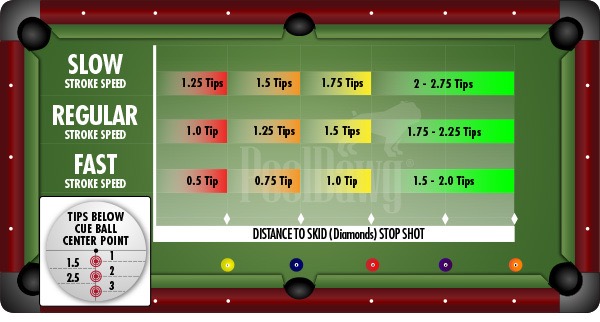
Cue ball motion of stop shot pool. Source: Pool Dawg
The key to the perfect stop shot pool is making sure the cue ball is in its “slide zone” at the exact moment it contacts the object ball. This is what allows for the complete transfer of energy.
To determine where this slide zone occurs, players should be able to answer:
- How low on the cue ball you strike
- How hard did you hit the cue ball
- The distance between the cue ball and the object ball
- The condition of the cloth (slicker cloth = longer slide)
How to Do a Stop Shot in Pool
Now for the practical part – how do you actually execute a reliable stop shot pool? Let’s break it down:
1. The Basic Technique
For a straight-in shot at medium distance:
- Position your cue slightly lower than center on the cue ball (roughly at the 5:30-6:30 position)
- Ensure your stroke is level and straight through the cue ball
- Use a medium-firm stroke – not too soft, not too powerful
- Follow through smoothly, but not excessively
2. Adjusting for Distance: The Key Formula
Here’s where many players go wrong. The distance between your cue ball and the object ball drastically changes where you need to hit the cue ball:
Short distance shots (under 12 inches):
- Hit almost dead center or just slightly below
- Use a medium-soft stroke
- The cue ball barely has time to start rolling, so minimal adjustment is needed
Medium distance shots (1-3 feet):
- Hit noticeably below the center
- Use a medium stroke
- This is where most practice happens, as it’s the most common distance
Long distance shots (over 3 feet):
- Hit much lower on the cue ball (significantly below center)
- Use a firmer stroke
- The longer distance means more cloth friction, requiring more initial backspin
The golden rule to remember: LOWER SPEED = LOWER TIP POSITION
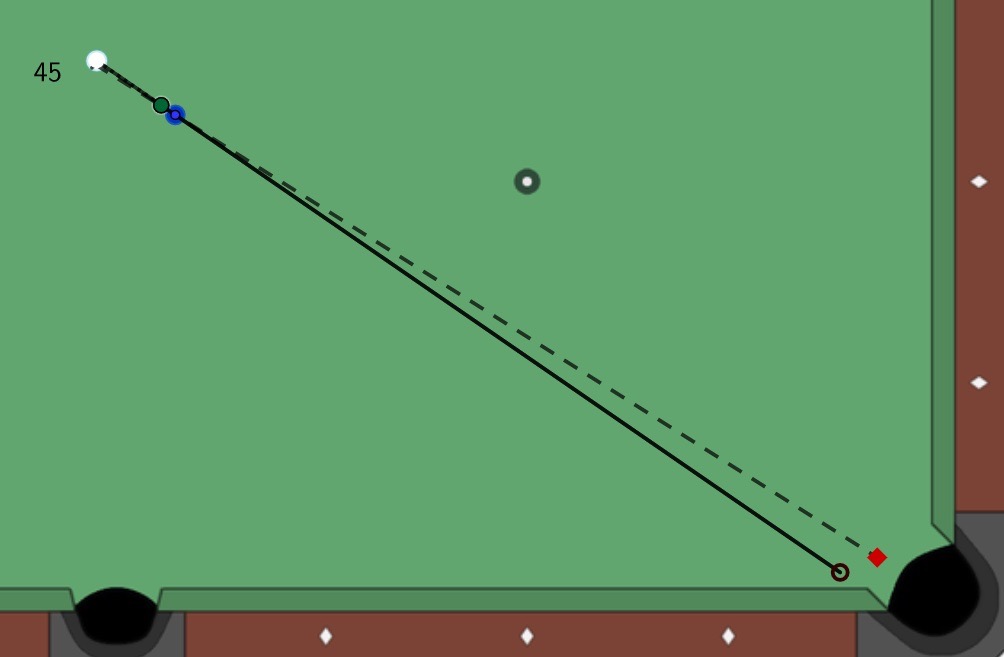
How to do a stop shot pool by measuring distance. Source: Billiards and Pool Principles, Techniques, Resources
If you’re shooting softly, you don’t need to hit as low. If you’re hitting harder, you’ll need to strike lower on the cue ball to achieve the stop.
3. Common Stop Shot Pool Mistakes
Watch out for these frequent errors:
- Unintentional side spin: Any left or right English will ruin your stop shot pool, causing the cue ball to slide sideways after contact
- Miscalculating the distance/speed ratio: Not adjusting your tip position based on how hard you’re hitting and how far the cue ball must travel
- Poor follow-through: Jabbing at the cue ball or stopping your stroke too quickly
- Inaccurate aim on the object ball: If you cut the object ball even slightly, the cue ball will deflect rather than stop
Why Is the Stop Shot Easier to Master Than Draw or Follow?
You might wonder why pool players can often master stop shots more reliably than draw (pull-back) or follow shots. There’s actually a scientific explanation:
As Dr. Dave explains in his technical analysis, the physics of the stop shot pool creates what mathematicians call a “flat spot” on the curve of possible outcomes. In practical terms, this means there’s a wider margin of error.
If your speed or tip position is slightly off, you’ll still get results close to a perfect stop. With draw or follow shots, small variations can produce dramatically different results.
