
Key Takeaways
- Carom billiards is a cue sport without pockets on the table.
- Players score points by hitting the opponent’s cue ball and the object ball with their cue ball in a single shot.
What is Carom Billiards?
Carom billiards, also known as French billiards or Carambole billiards, is a cue sport played on cloth-covered, pocketless tables. The main objective is to score points, or “counts,” by caroming your cue ball off both the competitor’s cue ball and the object ball in a single shot.
There are many variations of carom billiards, with some of the most renowned are:
- Straight rail
- One-cushion
- Balkline
- 3 cushion billiards
- Artistic billiards
Carom billiards remains popular in Europe, particularly in France, where it originated. It also appears in Asian countries such as Japan, the Philippines, South Korea, and Vietnam.
However, it has become relatively obscure in North America, where pool cue has taken precedence.
Equipment Needed to Play Carom Billiards
Carombala game requires less equipment than other cue sports. To start the game, you need the following gear:
1. Table
- Size and Structure: A pool table without pockets typically measuring 3.0 by 1.5 meters (10 ft × 5 ft).
- Cloth: Baize cloth, usually dyed green, made from 100% worsted wool without any nap.

A carom billiards table has no pocket.
2. Balls
The French billiards balls are larger and heavier than those used in pool or snooker.
- Set Composition: A standard set includes three balls: a white cue ball, a yellow cue ball (used to be white with spots), and a red object ball.
- Size and Weight: They have a diameter of 2.4 to 2.42 inches and a weight of 205 to 220 grams.
- Material: Modern balls are usually made from phenolic resin, polyester, or acrylic.
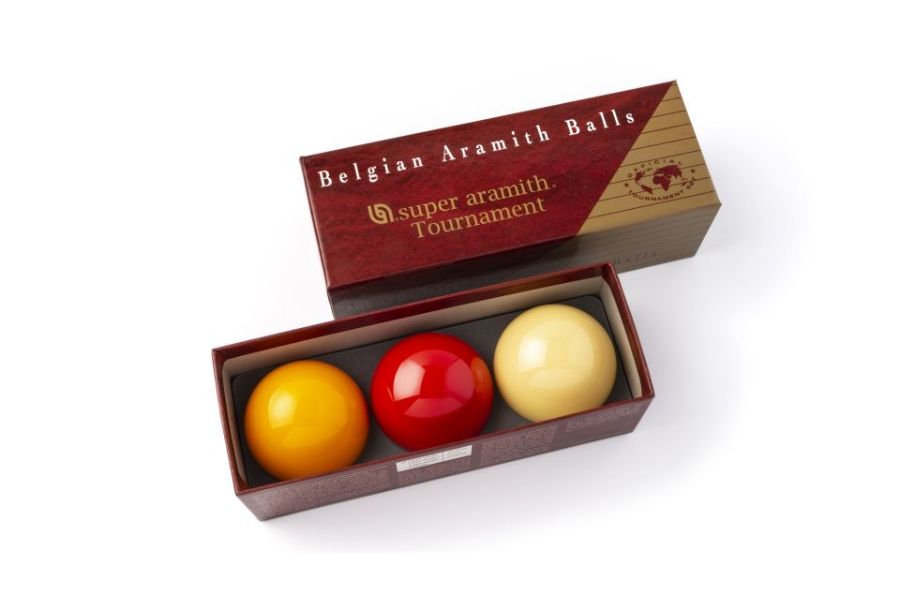
A standard carom billiards set has 3 balls.
3. Cues
Carom billiard cues are distinct from pool cues.
- Design: Generally shorter and lighter, with a shorter ferrule, thicker butt and joint.
- Dimensions: Typical carom cues are 54–56 inches long and weigh between 470 and 520 grams. The tip diameter ranges from 0.43 to 0.47 inches.
- Characteristics: These cues are stiffer to handle the larger, heavier balls and reduce deflection.
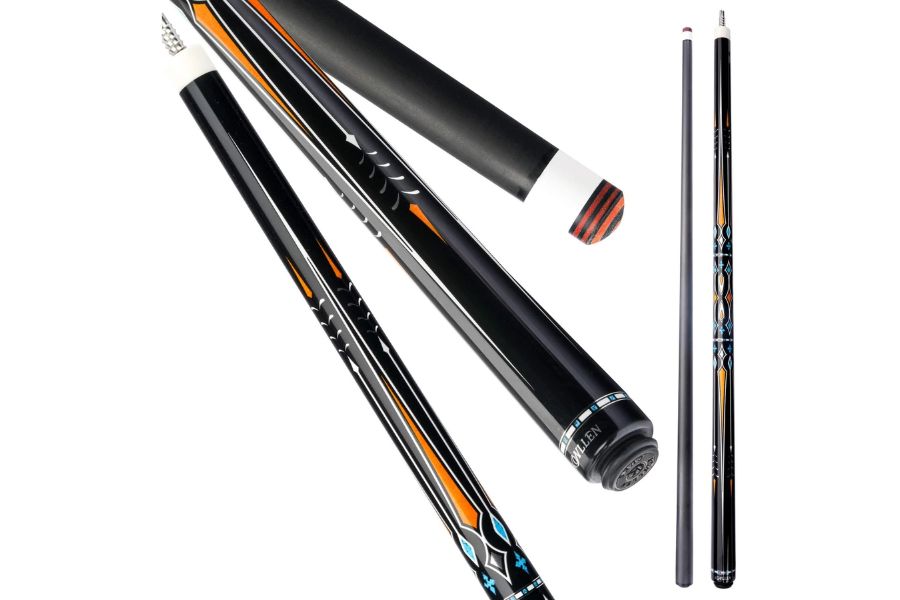
The cues used in 3 cushion pool.
Rules to Play Carom Billiards: You Must Know
The highest international governing body for competitive carom billiards is the Union Mondiale de Billard (UMB). Here are the vital rules they have outlined when playing carom billiards:
1. Setting Up
The red object ball is at the center of the table, while the two cue balls are at the opposite ends. This positioning provides equal opportunities for players to score and prevents unfair advantages.
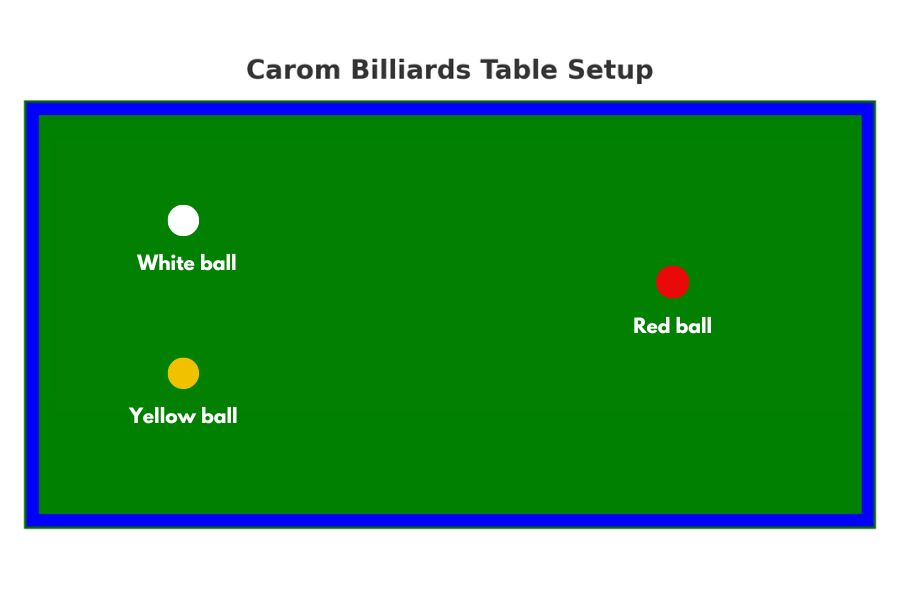
Carom billiards table setup
In carom billiards, players determine who shoots first by lagging (or stringing).
2. Scoring
The game aims to make as many cannons as possible within the match’s designated distance.
A cannon is made when the cue ball, set into motion by the stroke of the cue, contacts the two other balls. Each cannon counts as one point.
If the referee declares that a cannon is valid, the player continues their turn.
Otherwise, the referee may announce “missed,” and the player must end their turn.
3. Break During The Match
A 5-minute break occurs in the middle of the match.
The break will only happen if the match lasts at least 45 minutes, the player reaches half of the distance, and does not exceed 3/4 of the distance at that moment.
In matches with multiple sets, the break is as follows:
- In a 3-set match, after the 2nd set.
- In a 5-set match, after the 2nd and/or 4th set.
4. Fouls and Penalties
Players incur fouls for various infractions, such as:
- Touching balls with clothing or equipment during a shot.
- Making one or more balls bounce out of the billiard table during a stroke.
- Taking a shot before all three balls come to rest.
- Using any part of the cue other than the leather tip to make a shot.
If a foul occurs, the player’s turn ends, but there is no point penalty.
Understanding foul rules is crucial for maintaining game integrity and preventing unfair advantages. Besides, players can use strategies to capitalize on opponent fouls and gain a strategic edge during gameplay.
5. End Of The Match
The game typically ends when a player reaches a predetermined number of points:
- From 25 to 50 for amateurs.
- Up to 300 in professional tournaments.
How to Play Carom Billiards: Techniques & Strategies
Mastering the basic techniques in three-cushion billiards is essential for achieving consistent performance and precision. The foundation of these techniques lies in the correct stance and grip.
- Stance: Position your feet shoulder-width apart, with your front foot pointing towards the shot and your back foot providing stability. Relax your body yet firm it to allow smooth, controlled movements.
- Grip: Hold the cue stick lightly but firmly, with your dominant hand at the butt end of the stick. Your grip should be relaxed enough to create fluid movement but firm enough to control the cue.
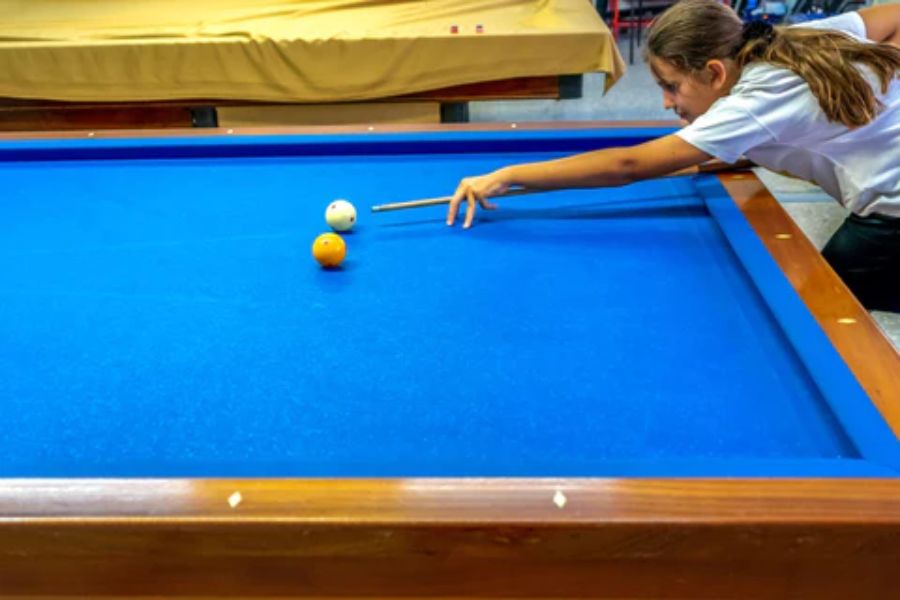
The stance in Carom billiards
Further, Carom billiards offers a variety of shot types, each requiring precision and strategic planning. You should practice these shot variations to enhance your versatility and scoring potential on the table.
| Shot Type | Details | What It’s For |
| Simple Carom | Strike the cue ball to make contact with both the competitor’s cue ball and the object ball in a single stroke. | Serve as the basis for more complex maneuvers. |
| Angle Carom (kisses) | Strike the cue ball so that it contacts one of the opponent’s balls before rebounding to hit the object ball. | Allow for subtle adjustments in rebound angles. |
| Three-Cushion Carom | Make the cue ball contact at least three cushions before contacting both the opponent’s cue ball and the object ball. | Get higher points and prepare strategic positioning. |
| Follow Shots (Top Spin) | Strike above center to propel the cue ball forward after contact. | Manipulate the cue ball’s spin to achieve desired carom trajectories. |
| Draw Shots (Backspin) | Strike below center to pull the cue ball back after impact. | Manipulate the cue ball’s spin to achieve desired carom trajectories. |
| Massé Shot | Make the cue ball struck with extreme spin, causing it to curve sharply around obstacles or make unexpected rebounds off cushions. | Escape difficult positions and create surprising angles. |
| Jump Shot | Strike the cue ball with a downward force to lift it off the table briefly. | Clear obstructing balls effectively. |
| Bank Shots | Strike the cue ball off one or more cushions before making contact with the object ball. | Navigate challenging positional scenarios and create scoring opportunities. |
Understanding and mastering these shot types will significantly enhance your strategic play and effectiveness in 3 rail billiards.
Frequently Asked Questions
What is the difference between carom and billiards?
- Carom Billiards (Carom): Played on a pocketless table. Players score points by making their cue ball strike both object balls in a single shot.
- Pocket Billiards (Billiards): Played on a table with pockets. Players use a cue ball to pocket objects into the pockets according to specific game rules.
